MENA Infrastructure Investment Projects: The Hidden Capital, Supply Chain,

Lead Researcher
Fatima Al-Zahra
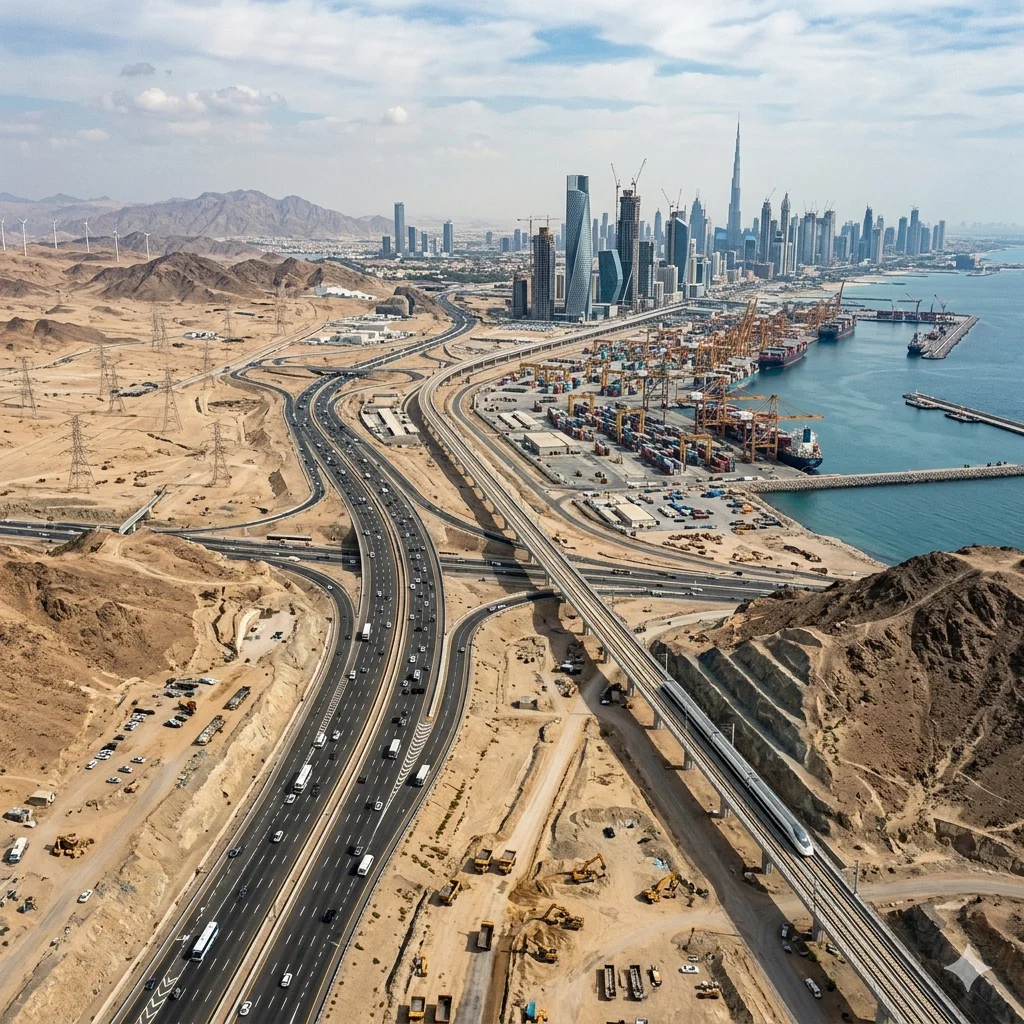
This article will analyze MENA infrastructure investment projects through
MENA Infrastructure Investment Projects: Capital, Supply Chain, and Technology Shifts Reshaping Growth
The Core Logic Behind MENA Infrastructure Spending
MENA infrastructure investment projects are no longer just about roads, ports, and power lines. In much of the region, infrastructure has become a policy instrument used to support trade competitiveness, industrial expansion, tourism capacity, and energy-system adjustment. That does not mean every project delivers those outcomes automatically. Large networks can also add fiscal pressure, create maintenance backlogs, or leave governments with underused assets if demand forecasts prove too optimistic.
The economic logic is still straightforward: countries that can move goods, people, electricity, and data at lower cost tend to attract more private activity. But the path from capital allocation to growth is uneven. A highway may reduce transport time, yet if customs delays remain high or industrial land is not serviced, the wider productivity gain can be limited. Similarly, a port expansion may improve headline capacity while berth productivity, inland rail links, or warehouse systems remain bottlenecks.
That is why infrastructure investment in MENA increasingly overlaps with industrial policy, logistics reform, tourism development, and the energy transition. The same project can be framed as a growth asset, a geopolitical signal, or a balance-sheet liability depending on how it is financed and executed. [IMAGE: A regional MENA map with transport corridors, ports, power grids, and digital nodes connected across deserts and coastal cities]
Why This Topic Requires Slow Analysis
This is a slow-analysis topic because announced pipelines often differ from funded commitments, and funded commitments often differ again from projects actually moving toward completion. Infrastructure investment announcements tend to be large and visible. Delivery, by contrast, is incremental and easier to miss: tender awards, land acquisition, grid interconnection, procurement lead times, and contractor mobilization usually determine whether a project becomes an operating asset.
Timeliness still matters. A new sovereign fund commitment, a multilateral loan, or a major EPC award can change the outlook quickly. But the deeper question is not whether a project was announced; it is whether the financing is closed, the permits are in place, the supply chain is available, and the construction schedule is realistic. In other words, the real value lies in distinguishing headline pipeline from bankable delivery.
That framework is especially important across MENA infrastructure investment projects because the region contains both highly liquid capital pools and physically constrained construction environments. A country may have strong sovereign backing but still face labor shortages, imported-material dependence, or utility coordination delays. Another may have ambitious reform plans but limited fiscal space. The differences matter more than the press release language. [IMAGE: Split-screen showing an announcement podium on one side and an active construction site on the other]
From Mega-Projects to Execution Capacity
The region has moved from an era defined mainly by large-scale ambition to one defined increasingly by execution capacity. Mega-projects still dominate headlines, but the market now rewards consistency in procurement, engineering, and delivery. The practical constraint is not only capital; it is the ability to convert capital into operating assets on time.
This can be seen in transport and urban development projects that look similar on paper but produce different outcomes in practice. For example, the Dubai Metro Blue Line was awarded in 2024 as a major extension to an already operating system, with official disclosures describing a project designed to expand connectivity rather than create a greenfield network from scratch. Because it builds on existing rail operations, its implementation risk is structurally different from a new metro in a city without an established transit backbone. By contrast, new city-scale rail concepts elsewhere in the region can face longer lead times because they require land assembly, utility relocation, rolling-stock procurement, and institutional coordination before construction even becomes visible.
Source note: Dubai RTA and official UAE reporting on Blue Line award, 2024.
Execution capacity also depends on the construction labor pool and the availability of project managers who can coordinate multiple packages. A country can announce a large capital program, but if contractors are competing for the same tunneling crews, electrical equipment, and specialized engineers, schedules tend to slip. That means the largest project is not always the most impactful one. Often, the more important differentiator is whether a government or developer can repeatedly deliver mid-sized assets that start generating revenue or public-service benefits sooner.
Financing Structures: What the Funding Mix Reveals About Risk
The financing structure of a project often reveals more than its headline value. Public funding usually signals policy priority, while sovereign wealth participation can indicate strategic commitment and long-duration patience. PPPs may suggest an attempt to shift construction and demand risk to the private sector, though they do not eliminate state exposure. Export credit agencies often appear where equipment imports are large. Multilateral lenders typically join when project governance, environmental standards, and repayment capacity have passed a higher level of scrutiny.
One useful comparison is between projects that are mostly funded from the state budget and those that have identifiable lender commitments. In Egypt, the Abu Qir Container Terminal project at Alexandria has been associated with a large development push to expand port capacity and logistics throughput. Public reporting and official statements indicate a multi-phase structure involving state and private participation, but the more important analytical point is that port projects of this type require not just civil works funding but also terminal operator agreements, equipment procurement, and inland access coordination before they become fully bankable.
Source note: Egyptian government and port authority disclosures, 2023–2024.
A second example is Saudi Arabia’s Red Sea and gigaproject-related infrastructure, where funding often combines sovereign backing, developer-level capital, and state-directed land and utility preparation. Some components are commercial, while others remain policy-led and depend on broader destination-development goals. Here, the financing mix tells analysts that short-term profitability may not be the only criterion; however, it also means returns can be harder to benchmark and timelines more sensitive to macro conditions.
Source note: Saudi official project announcements and developer reporting, 2023–2025.
The difference between an announced budget and a funded project is critical. A $10 billion plan with no tender award is not equivalent to a $2 billion project with signed lending documentation, procurement milestones, and visible site mobilization. For readers tracking infrastructure investment, the relevant verification steps are: budget source, lender commitments, procurement status, and whether the project has entered the construction or commissioning phase.
Supply Chain Dependency: The Underreported Constraint on Build-Outs
The construction supply chain is one of the least visible but most important constraints on regional delivery. Many MENA infrastructure investment projects rely on imported steel, cement additives, rolling stock, turbines, switchgear, semiconductors, and signaling systems. That dependence increases exposure to shipping delays, exchange-rate changes, and supplier concentration risk.
This is particularly relevant for rail, energy, and data infrastructure. A metro project may be funded and approved, but if signaling components are sourced from a limited set of international suppliers, delivery can be delayed by long lead times. The same applies to transformer procurement for power networks or switchgear for industrial zones. In some cases, the bottleneck is not civil works but the imported technical package.
The Abu Dhabi railway network build-out, part of wider Etihad Rail development, illustrates this point. Even where earthworks and track sections advance, the timing of system integration, rolling stock, and signaling remains tied to specialist suppliers. In rail projects, import dependence is not a side issue; it is often the schedule driver.
Source note: Etihad Rail official updates and UAE government reporting, 2023–2025.
Localization policies are one response, but they are not cost-free. Requiring local content can improve resilience, shorten future maintenance lead times, and support industrial learning. It can also raise unit costs if domestic suppliers are still scaling. The trade-off is clearest in standardizable items such as cable trays, concrete segments, pipes, and basic steel fabrication. Local sourcing can work well there because specifications are repeatable and volume is high. But for highly specialized systems — for example, rail signaling or gas-turbine controls — domestic substitution may increase project risk unless the local ecosystem already has technical depth.
A practical example comes from Saudi industrial localization policies linked to infrastructure and procurement. The policy logic is to build a more durable domestic supply base over time, but the short-term cost can be higher if imported alternatives remain cheaper or faster. The policy question is therefore not whether localization is good in principle, but which components justify the trade-off between resilience and cost.
Source note: Saudi industrial and procurement localization programs, official releases, 2023–2025.
Digital Infrastructure Is Becoming Part of the Core Asset Base
Infrastructure investment in MENA is also shifting from purely physical assets to hybrid physical-digital systems. Ports now depend on terminal operating software, customs digitization, and traffic-management platforms. Utilities require smart metering, distribution automation, and cyber resilience. Rail systems depend on integrated signaling and passenger-data platforms. In other words, the value of a road or port increasingly depends on the digital layer running through it.
This matters because digital infrastructure has different economics from concrete and steel. It can scale faster, but it also needs standards, cybersecurity, and interoperability. A government may complete a roadway on schedule and still fail to unlock full benefit if weigh-in-motion systems, tolling platforms, or logistics data interfaces are missing. The same logic applies to ports: physical capacity does not automatically translate into faster dwell times if the digital customs chain remains fragmented.
The Gulf Cooperation Council has been especially active in this area, with smart-city frameworks, cloud-region investments, and telecom modernization increasingly folded into national development plans. The shift is visible in public-sector procurement and in private operator behavior, where logistics, utilities, and transport firms now treat software and data integration as core infrastructure rather than support functions.
Source note: GCC digital economy and smart infrastructure programs, official announcements and operator reporting, 2023–2025.
Verified Projects Show the Gap Between Announcement and Delivery
A few recent projects show why verification must be embedded in any analysis of MENA infrastructure investment projects:
- Dubai Metro Blue Line (UAE, 2024 award): A verified contract award on an existing rail system, which lowers some development risks but still requires staged delivery and integration.
- Abu Qir Container Terminal (Egypt, 2023–2024 disclosures): A large port expansion backed by public statements and development planning, but with execution dependent on terminal equipment, operator arrangements, and connectivity.
- Etihad Rail network expansion (UAE, 2023–2025 updates): Visible progress on a national rail backbone, with schedule sensitivity tied to systems integration and procurement.
- Riyadh metro-related urban transit rollout (Saudi Arabia, commissioning phase 2024): A major urban transport asset moving from construction to operation, demonstrating that commissioning is a separate milestone from capital expenditure.
- NEOM-related enabling infrastructure (Saudi Arabia, 2023–2025): Large-scale development with substantial public capital signaling, but with execution timelines that remain multi-year and dependent on phased infrastructure build-out.
The point is not that these projects are identical. It is that each one sits at a different point on the pipeline: announced, awarded, under construction, or entering operations. That distinction determines whether the project can be counted as near-term infrastructure supply or only as future capacity.
What Will Matter Most Going Forward
The next phase of MENA infrastructure growth will likely depend less on the number of announcements and more on three practical factors: financing quality, supply-chain resilience, and digital integration. Projects with clear lender backing, staged procurement, and operational interfaces are more likely to move from paper to asset. Projects that depend on broad fiscal support, imported specialized equipment, and unresolved land or utility issues will remain exposed to delay.
For policymakers, the challenge is to avoid treating infrastructure as a one-dimensional spending category. A port, rail line, airport, or power corridor only creates durable value when it is financed credibly, built with manageable supply risk, and integrated into the wider economic system. For investors and analysts, the more useful question is not whether a project exists, but whether it has crossed the threshold from announcement to executable delivery.
That is why the most meaningful developments in MENA infrastructure investment projects are often not the largest headlines. They are the contract awards, financing closings, procurement milestones, and commissioning dates that show which countries can consistently turn capital into operating infrastructure.