Beyond the Footer: What YouTube''s Legal Links Reveal About Platform Governance

Lead Researcher
Fatima Al-Zahra
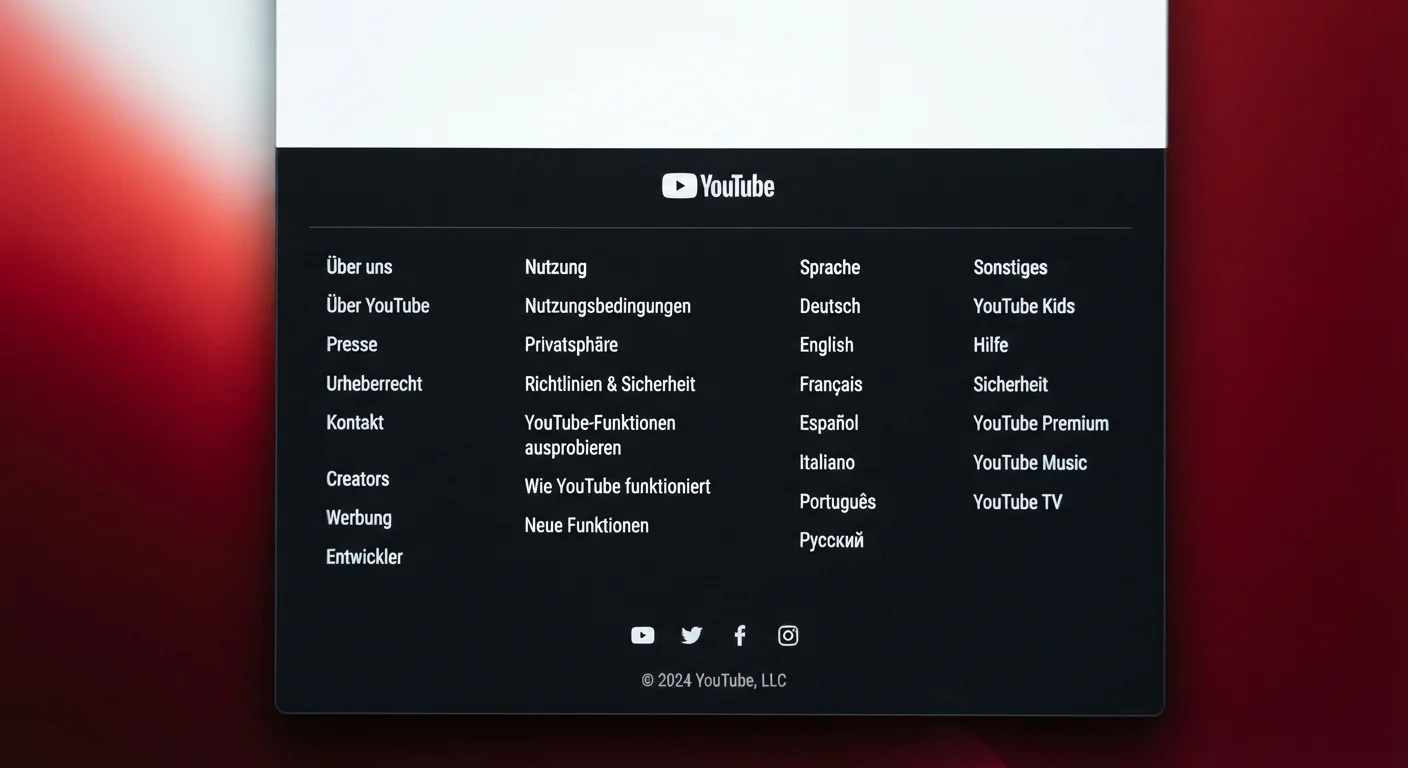
The seemingly mundane footer of YouTube's website is a strategic document
YouTube’s Footer in 2026: A Compliance Map for the Digital Age
Introduction: The Footer as a Legal and Business Blueprint
Most internet users scroll past it without a second glance. Sandwiched between the last video thumbnail and the endless void of white space, the footer of YouTube’s website appears as a routine afterthought—a necessary but forgettable collection of links, disclaimers, and corporate boilerplate. But in 2026, that same strip of text has become something far more consequential: a strategic document that reveals how one of the world’s largest platforms navigates a fractured regulatory landscape while protecting its business model.
[IMAGE: Stylized screenshot of YouTube’s footer with links in German and English, blurred for abstraction]
The copyright notice stamped “2026” is not merely a placeholder. It signals long-term operational planning and a commitment to regulatory continuity. Beneath it, a carefully curated set of hyperlinks—some in English, others specifically in German—offers a window into how Google LLC manages compliance across jurisdictions, particularly under the European Union’s Digital Services Act (DSA) and Germany’s uniquely strict liability laws. Each link has an economic logic. Each represents a decision about user trust, legal risk, and commercial opportunity. To understand platform governance in the mid-2020s, one need only look at the bottom of the page.
The EU Regulatory Footprint: Impressum, Datenschutz, and DSA
Among the most revealing links in YouTube’s footer are those that have no direct equivalent in the United States: “Impressum” and “Datenschutz.” The Impressum is a legal requirement in Germany, Austria, and several other German-speaking jurisdictions, mandating that commercial websites display a clear disclosure of their publisher’s identity, address, and contact information. For YouTube, this means providing a page that lists Google Germany GmbH’s registered office, managing directors, and regulatory supervisory authority.
[IMAGE: Map of Europe with Germany and Austria highlighted, showing countries with strict imprint laws]
The “Datenschutz” link, meanwhile, connects to YouTube’s privacy policy—a document that must comply not only with the General Data Protection Regulation (GDPR) but also with the DSA’s enhanced transparency obligations. Since 2024, the DSA has required platforms to provide users with easily accessible information about content moderation decisions, algorithmic recommendation systems, and advertising targeting. YouTube’s footer responds to this by including “Richtlinien & Sicherheit” (Policies & Safety), which directs users to community guidelines, reporting tools, and explanations of how content is reviewed.
The presence of these links is not optional. Platforms with more than 45 million monthly active users in the EU—a threshold YouTube easily exceeds—must designate a legal representative in the bloc and offer clear, plain‑language explanations of their moderation practices. By embedding these references in the footer, YouTube creates a persistent, low‑friction pathway for users to exercise their rights under the DSA, including the right to appeal content removals and to understand why they see certain advertisements.
What is striking is the location: the footer is the last thing users see before leaving the page. Placing legal disclosures there is a deliberate choice, balancing regulatory compliance with user experience design. Critics argue that this positioning makes the information less visible; advocates contend that it ensures the links are always present without cluttering the main interface. Either way, the footer has become the frontline of legal defense.
Contractual Transparency: ‘Verträge hier kündigen’ and User Rights
Perhaps the most unusual link in YouTube’s footer—especially for non‑German users—is “Verträge hier kündigen,” which translates to “Cancel contracts here.” This is not a general customer service page. It is a direct response to German consumer protection law, specifically the right of withdrawal (Widerrufsrecht) that applies to digital services sold as subscriptions.
[IMAGE: Icon of a contract document with a cancellation symbol (red cross) over it]
For YouTube, this means providing a straightforward, self‑service mechanism for users to terminate premium subscriptions, YouTube Music memberships, or channel memberships. In Germany, the law requires that cancellation be as easy as signing up—a principle that has forced platforms to move away from lengthy phone‑based cancellation processes. By dedicating a footer link to contract cancellation, YouTube demonstrates compliance while also reducing the operational cost of customer support calls.
This trend extends beyond Germany. The European Union’s Omnibus Directive, which came into full effect in 2022, already mandated simplified cancellation rights across the bloc. But Germany’s implementation goes further, requiring explicit cancellation buttons and transparent confirmation emails. YouTube’s footer link is a direct manifestation of this regulatory environment.
The economic logic is subtle but powerful. By making cancellation easy, YouTube reduces the number of disputes that escalate to consumer protection agencies or court. It also signals to regulators that the platform is not engaging in “dark patterns” that trap users in unwanted subscriptions. For a company that derives a growing share of revenue from subscription services (YouTube Premium, YouTube TV, and Music), maintaining this trust is essential. The footer link is, in effect, a cost‑saving compliance tool.
Business Ecosystem: ‘Werben’ (Advertising) and ‘Entwickler’ (Developers)
While the legal links serve compliance, two other footer entries—’Werben’ (Advertise) and ‘Entwickler’ (Developers)—are pure commercial gateways. These are not mandated by any law; they exist because YouTube needs to funnel traffic toward its revenue‑generating services.
[IMAGE: Flowchart showing arrows from footer links to Google Ads interface and YouTube API documentation]
The “Werben” link leads to Google Ads, where businesses can create video campaigns, set budgets, and target audiences. For creators, it also connects to the YouTube Partner Program, which monetizes their content. In 2026, as digital advertising faces increased scrutiny over brand safety and ad placement, this link is also a compliance tool: it directs advertisers to pages explaining how YouTube verifies content suitability, complies with the DSA’s transparency requirements for political ads, and manages ad‑free inventory.
The “Entwickler” link, meanwhile, opens the door to YouTube’s developer ecosystem—APIs, SDKs, and tools that allow third‑party apps to interact with the platform. This is a strategic asset. By making the developer portal easily accessible from the footer, YouTube encourages integration, data sharing, and innovation that ultimately strengthens its network effects. However, it also carries regulatory implications: under the DSA, platforms must provide developers with clear terms of service and data access policies. The footer link serves as a permanent point of reference for those who build on top of YouTube’s infrastructure.
Together, these two links reveal a dual reality: the footer is both a shield (compliance) and a sword (commercial conversion). YouTube uses the same real estate to fulfill legal obligations and to drive business growth.
Copyright and Press: Managing Content and Reputation
Two more footer links—’Copyright’ and ‘Press’—address the platform’s most persistent operational challenges: intellectual property disputes and public relations.
[IMAGE: Gavel and microphone on a wooden desk, symbolizing legal and media management]
The “Copyright” link leads to YouTube’s copyright policies, including the Content ID system that automatically identifies and manages copyrighted material. In 2026, copyright remains one of the most litigious areas for any user‑generated content platform. The DSA introduced new obligations for platforms to respond to copyright claims quickly and to provide counter‑notice mechanisms. YouTube’s footer ensures that rightsholders—whether major studios or independent musicians—can find the necessary tools without searching through menus.
The 2026 copyright notice at the bottom of the page (© 2026 Google LLC) is a standard legal declaration, but it also carries symbolic weight. It asserts that the platform’s content and design are protected, while simultaneously acknowledging that much of the user‑uploaded content is subject to third‑party rights. This careful balance is reflected in the link itself: a one‑stop shop for takedown requests, licensing agreements, and fair use explanations.
The “Press” link, meanwhile, is a media relations portal. It provides journalists with official statements, executive bios, and embargoed announcements. In an era of rapid news cycles and regulatory investigations, having a direct line to the platform’s communications team is crucial for managing narrative. The footer makes this information permanently available, reducing the need for ad‑hoc email inquiries. It also serves as a subtle reminder that YouTube is willing to engage with the press—a form of soft reputation management.
Global Implications and Future Trends
YouTube’s 2026 footer is not solely a European document. It reflects a reactive, jurisdiction‑by‑jurisdiction approach to regulation that is increasingly becoming the norm for global platforms. As more countries adopt laws similar to the DSA—Japan, Brazil, India, and Canada are all considering or have passed platform accountability legislation—the footer will need to grow ever more complex.
[IMAGE: World map with multiple countries highlighted, showing expansion of platform governance laws]
One can imagine a future where footers contain country‑specific sections, toggled by IP address or language preference. The German links might be replaced by versions for Brazil (Marco Civil da Internet) or India (IT Rules 2021). The “Verträge hier kündigen” link might become a universal cancellation portal, as similar consumer protection laws spread.
Another trend is the increasing use of the footer for transparency reporting. Some platforms already link to regular transparency reports in their footer. In 2026, we may see links to real‑time dashboards showing content removal rates, government requests, and advertising data. The DSA requires platforms to publish such data quarterly; embedding the link in the footer ensures constant accessibility.
For YouTube, the footer of 2026 is both a legal document and a strategic asset. It tells us that the platform is preparing for a future where regulation is not an exception but the baseline. It tells us that user trust is built through transparency—even in the small print. And it reminds us that in the digital age, nothing is truly peripheral. Even the bottom of the page matters.