MENA Policy Regulation Analysis: What an ARDL Study Reveals About Growth,

Lead Researcher
Karim El-Sayed
This article examines an empirical study on economic policy effectiveness
MENA Policy Regulation Analysis: What an ARDL Study Reveals About Growth, Inflation, and Stability Across 20 Countries
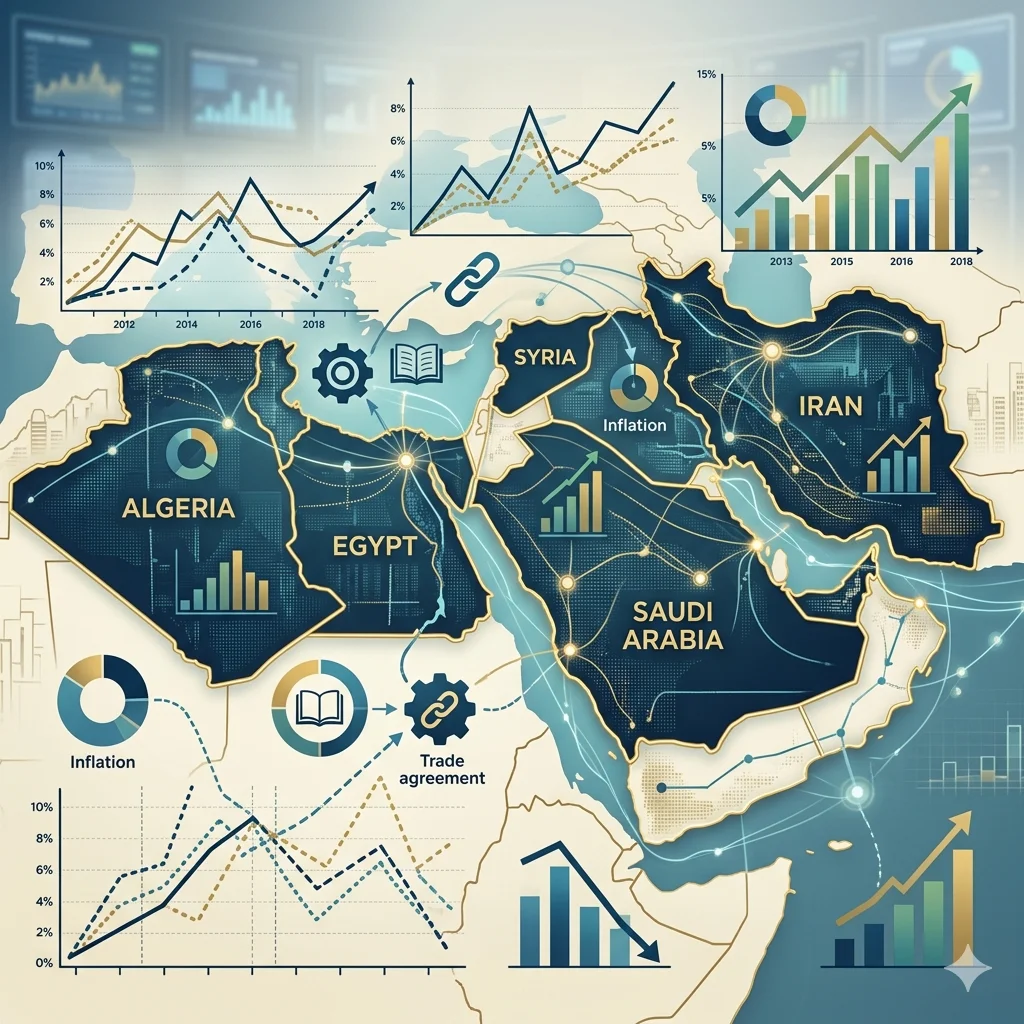
[IMAGE: A professional editorial illustration of the MENA region map overlaid with economic charts, time-series lines, inflation and growth indicators, and policy symbols in a blue-and-gold palette.]
Why This MENA Study Matters Now
A recent empirical study on economic policy effectiveness in the Middle East and North Africa offers a useful lens for reading one of the region’s central policy questions: how do monetary and fiscal tools affect growth and stability in economies that differ widely in structure, income level, and institutional capacity?
The paper examines 20 MENA countries from 2000 to 2023, a period that includes commodity shocks, financial stress, regional conflict, pandemic disruption, and uneven recovery. That time span matters because policy transmission in the region has not been uniform. In some cases, policy measures have filtered through formal banking systems and government budgets; in others, weak institutions, exchange-rate pressure, or shallow financial markets have reduced their impact.
The study suggests that the region’s policy challenge is not simply to “do more” or “do less,” but to understand how money supply, inflation, government spending, and structural reforms interact over time. That is the central analytical question behind the paper: which policy channels appear to support growth and which ones are associated with instability or weaker adjustment?
[IMAGE: A map of the MENA region with small economic indicators hovering over different countries.]
Source Verification and Publication Context
The study was authored by Bouyacoub Brahim of the University of Oran II, Department of Economics, Faculty of Economics, Algeria. It appeared in _Financial Markets, Institutions and Risks_, volume 8, issue 1, on pages 158–172. The DOI is 10.61093/fmir.8(1).158-172.2024.
The publication timeline is also clearly documented: received 12.01.2024, accepted 16.03.2024, and published 31.03.2024. That relatively fast turnaround should not be read as either a strength or a weakness by itself, but it does indicate that the paper moved through review in a short window.
These bibliographic details are important because they anchor the discussion in a specific source rather than a general policy claim. What follows separates, as much as possible, what is directly reported in the paper from broader interpretation.
[IMAGE: A journal-style document layout with a magnifying glass highlighting DOI, author, and publication date fields.]
The Core Analytical Axis: Policy Transmission in Mixed MENA Economies
At its core, the study is about policy transmission under heterogeneous conditions. That matters in MENA because the region includes oil exporters and importers, fixed and managed exchange-rate regimes, more and less diversified labor markets, and varying degrees of fiscal and monetary credibility.
The paper focuses on four broad policy-related variables:
- Money supply
- Inflation
- Government spending
- Structural reforms
Rather than treating these as isolated levers, the study approaches them as linked policy channels. In practice, this means that a change in liquidity may influence prices, investment, and consumption differently depending on whether the economy is already constrained by inflation, weak demand, or limited productive capacity. Similarly, government spending may support output in one setting while becoming less effective in another if it is not accompanied by institutional or structural improvements.
The broader policy implication is straightforward: in mixed MENA economies, the same nominal policy move can generate different real outcomes depending on absorption capacity, credibility, and the quality of implementation.
[IMAGE: A systems diagram showing policy levers feeding into growth, inflation, investment, employment, and stability.]
Why ARDL Is Suitable for This Question
The paper uses an ARDL regression model estimated with OLS, which is a sensible choice for this kind of macroeconomic analysis. ARDL, or Autoregressive Distributed Lag, is often used when researchers want to distinguish between short-run effects and long-run relationships in time-series or panel settings.
That distinction matters here because policy effects do not occur all at once. A fiscal expansion can support output quickly but create later inflation pressure. Monetary changes may affect prices with a lag. Structural reforms may take several years before they influence investment or employment. ARDL is designed to capture those delayed and dynamic responses.
The use of OLS within the ARDL framework helps estimate the model in a form that is easier to interpret while still preserving the lag structure. For readers, that means the paper is not just asking whether policy variables are correlated with growth, but whether their effects persist or fade over time.
The 2000–2023 sample also includes multiple shocks and regime shifts. That makes a dynamic specification more appropriate than a simple cross-sectional comparison, because the region’s policy environment has not been stable enough for a purely static model to be informative.
[IMAGE: A timeline chart showing policy lags, shocks, and delayed responses across multiple years.]
Main Empirical Findings
According to the paper, the results point to a differentiated pattern across policy variables rather than a single uniform effect.
1. Money supply is not neutral in the MENA context
The study finds that changes in money supply are linked to macroeconomic outcomes in ways that depend on the surrounding policy environment. In some cases, greater liquidity may support activity; in others, it may add to inflationary pressure if productive capacity and financial intermediation are weak.
This matters because it challenges a simplified reading of monetary expansion as automatically growth-friendly. The paper’s evidence suggests that monetary effects are conditional, not universal.
2. Inflation reduces policy effectiveness
Inflation emerges as a central constraint. The paper indicates that higher inflation is associated with weaker growth performance and less stable adjustment dynamics. That result is consistent with a broader macroeconomic argument: once inflation becomes entrenched, it distorts planning, erodes purchasing power, and complicates investment decisions.
For MENA economies, the relevance is practical. Inflation is not only a price-level issue; it is also a transmission problem. When inflation rises, policy tools often become less predictable in their effects.
3. Government spending can support growth, but quality matters
The study suggests that government spending has a more favorable association with growth when fiscal outlays are targeted and aligned with productive priorities. However, the paper also implies that spending alone is not enough. If fiscal policy is poorly allocated, crowded out by recurrent expenditures, or detached from structural constraints, its growth effects can be limited.
This is one of the paper’s more important results because it places emphasis on fiscal quality, not just fiscal size.
4. Structural reforms are associated with stronger medium-term adjustment
The article indicates that structural reforms play a meaningful role in improving economic performance over time. In the paper’s framework, reforms appear to matter because they can improve the economy’s capacity to absorb policy shocks, attract investment, and support labor-market adjustment.
This is not presented as an instant effect. Rather, the evidence points to reforms as an enabling condition for more durable policy transmission.
[IMAGE: A split-screen illustration showing inflation pressures on one side and reform-driven stability on the other.]
What the Results Suggest About Country Heterogeneity
One of the most important takeaways is that the 20-country panel should not be read as evidence that every MENA economy behaves in the same way. The paper’s findings imply significant country-level heterogeneity.
Oil-rich economies may have stronger fiscal buffers and more space for countercyclical spending, while import-dependent economies are more exposed to exchange-rate movements and imported inflation. Countries with deeper banking systems may transmit monetary changes more effectively than those with fragmented financial sectors. Similarly, economies with stronger institutions may convert reforms into growth more quickly than those where implementation is uneven.
So, while the paper identifies common policy patterns, it also supports a more cautious conclusion: policy effectiveness in MENA is conditional on domestic structure. The same ARDL-estimated relationship can therefore point to different policy priorities across countries.
Limitations and Caveats
The paper is useful, but several caveats matter.
First, a 20-country panel across 23 years inevitably compresses substantial national variation. Even if the model is well specified, averaging across countries can conceal important differences in policy regime, conflict exposure, or institutional quality.
Second, ARDL can identify dynamic associations, but it does not by itself prove full causality. The study is informative about timing and direction, yet some relationships may still reflect reverse causality or omitted structural factors.
Third, regional data quality is uneven. For MENA economies, measurement differences in government spending, inflation, and reform indicators can affect comparability. That does not invalidate the findings, but it does mean the results should be treated as evidence of broad tendencies rather than exact policy coefficients for every country.
Finally, the paper focuses on macro-level variables. It does not fully capture distributional effects, informal-sector adjustment, or sector-specific responses. Those omissions are common in cross-country studies, but they matter when translating findings into policy design.
Policy Implications for the Region
Taken together, the paper points to a policy logic that is more conditional than prescriptive.
For monetary policy, the message is that liquidity support must be paired with credibility and price stability. Expanding money supply in a weak institutional setting may not produce the intended growth effect.
For fiscal policy, the key issue is not only the size of spending, but its composition. Investment in infrastructure, productive capacity, and labor absorption is likely to be more effective than broad recurrent expenditure.
For structural reform, the study’s findings imply that reforms are not an optional complement to macro policy. They appear to shape whether policy transmission works at all. That includes labor-market flexibility, business-environment improvements, and institutional strengthening.
For regional convergence, the implication is that MENA economies may benefit from policy coordination, but convergence will depend on each country’s capacity to implement reforms and maintain macroeconomic stability.
Conclusion
This ARDL study of 20 MENA countries from 2000 to 2023 does not suggest a single policy formula. Instead, it shows that macroeconomic outcomes in the region depend on how monetary conditions, inflation, fiscal policy, and structural reform interact over time.
The paper’s main contribution is to move the discussion away from one-variable policy debates and toward a more realistic view of transmission: growth and stability are shaped by the alignment of policy tools with institutional capacity and economic structure. In that sense, the findings are less about one country outperforming another and more about why policy works in some settings and underperforms in others.
For analysts and policymakers, that is the more useful lesson.