The MENA Deep Dive: Unpacking the Hidden Logic of Economic Diversification

Lead Researcher
Dr. Youssef Ibrahim
This report goes beyond headlines to uncover the underlying economic architecture
The MENA Deep Dive: Unpacking the Hidden Logic of Economic Diversification and Tech-Led Growth
Introduction: The Quiet Revolution Beneath the Sand
For decades, the Middle East and North Africa (MENA) has been framed in global discourse as a region defined by its hydrocarbon wealth—a narrative of oil rigs, petrodollar flows, and geopolitical rent distribution. That story, while still partially accurate, increasingly obscures a far more profound transformation underway beneath the surface. Today, MENA economies are quietly executing one of the most ambitious economic pivots in modern history: using fossil-fuel rents as venture capital to build a non-oil, technology-driven future.
This is not a linear transition. It is a hidden loop—one in which revenues from crude exports are systematically channeled into digital infrastructure, sovereign innovation funds, and knowledge-based supply chains that will eventually render the region less dependent on the very commodity that bankrolls them. Most analysts, focused on quarterly oil price fluctuations or short-term political headlines, miss the structural architecture being assembled over decades.
The numbers already betray the shift. According to the International Monetary Fund, non-oil GDP growth in Saudi Arabia reached 4.4% in 2023, outperforming the overall economy. The UAE’s non-oil sector expanded by 6.2% in the same period, while Qatar’s non-hydrocarbon economy grew at 4.1%. These are not anomalies—they are the early dividends of a deliberate strategy to decouple economic performance from energy markets. By examining the long-term patterns rather than short-term events, we can uncover the hidden logic that is quietly reshaping the MENA landscape and creating new realities for global investors, policymakers, and businesses.
[IMAGE: A split image: left side shows an oil rig silhouetted against a sunset, right side shows a futuristic tech campus with glowing data servers and solar panels covering the roof.]
The New Oil: How Digital Infrastructure Became the Region’s Strategic Asset
The most visible expression of this transformation is the massive build-out of digital infrastructure across MENA. Data centers, 5G networks, cloud hubs, and subsea cable landing stations are sprouting from the desert with the same urgency that oil pipelines once commanded. Saudi Arabia’s NEOM project, beyond its futuristic city ambitions, includes a planned $500 billion investment in cognitive cities built on ubiquitous connectivity and artificial intelligence. The UAE has embedded an artificial intelligence strategy into its national agenda, appointing the world’s first Minister of AI in 2017 and launching a $15 billion AI and digital economy fund in 2023.
The underlying logic is not merely about technological modernization. It is about digital sovereignty and the ambition to become a global data corridor linking Asia, Africa, and Europe. More than 90% of data traffic between Europe and Asia already passes through the Middle East, and countries like Oman, Egypt, and the UAE are racing to capture and process that data within their borders rather than letting it transit uncaptured. Strategic investments in submarine cable systems—such as the 2Africa cable, the Middle East Europe cable, and the Blue-Raman cable—are turning the region into a physical hub for global internet traffic.
World Bank data confirms the acceleration: internet penetration in the MENA region grew by over 200% in the decade ending 2023, from 28% in 2013 to nearly 85% in 2023 in the Gulf states. McKinsey estimates that the digital economy currently contributes about 4% to MENA’s GDP, a figure expected to double by 2030. While still modest compared to mature digital economies, the trajectory is steep. Critically, these investments are not consumption-driven; they are designed to create exportable digital services and attract global tech companies to establish regional headquarters. Amazon Web Services, Microsoft Azure, Google Cloud, and Oracle have all opened multiple data center regions in the UAE, Saudi Arabia, and Israel over the past three years.
[IMAGE: Map of MENA with glowing data cables connecting major cities (Riyadh, Dubai, Doha, Abu Dhabi, Tel Aviv, Cairo, Muscat), overlaying submarine cable routes (colored lines) and data center locations (pulsing dots).]
Sovereign Wealth Funds: The Hidden Venture Capitalists
If digital infrastructure is the hardware, sovereign wealth funds (SWFs) are the operating system driving the transformation. The region’s largest SWFs—Saudi Arabia’s Public Investment Fund (PIF), the UAE’s Mubadala Investment Company, and Qatar Investment Authority (QIA)—have undergone a fundamental strategic shift over the past decade. They are no longer passive holders of global blue-chip stocks and bonds; they are active venture builders, deploying capital directly into technology, clean energy, biotech, and advanced manufacturing.
The PIF exemplifies this pivot. With assets under management exceeding $700 billion, it has committed $45 billion to technology investments through initiatives like the $10 billion AIV fund focused on disruptive tech, and a $5 billion partnership with BlackRock for climate infrastructure. Mubadala, meanwhile, has built a portfolio that includes stakes in semiconductor manufacturers (GlobalFoundries, TSMC), AI chip startups, and renewable energy assets across the Americas and Europe. QIA has invested heavily in fintech, healthtech, and electric vehicle infrastructure.
What makes these funds unique—and what many market observers underestimate—is their long-term supply chain impact. By investing in companies across the entire value chain, from battery manufacturing to solar panel fabrication to satellite communications, they are creating new industrial ecosystems that bypass traditional oil logistics. The PIF’s creation of Lucid Motors’ first international manufacturing plant in Saudi Arabia, backed by a $3.7 billion investment, is not merely about electric vehicles. It catalyzes a local supply chain for battery components, charging infrastructure, and advanced materials that would otherwise rely on imported oil derivatives.
S&P Global data show that MENA sovereign wealth funds collectively invested $87 billion in 2023, with technology and renewables accounting for 62% of deal value—up from 28% in 2018. These funds are now among the world’s largest venture capital investors, and their influence extends far beyond their home markets. They are reshaping the global innovation landscape by providing patient capital that Western institutional investors often avoid.
[IMAGE: Infographic showing a network of logos of MENA sovereign wealth funds (PIF, Mubadala, QIA, ADIA, ICD) connected to global tech companies (Uber, Lucid, Magic Leap, Relativity Space, SpaceX, GlobalFoundries) with arrows representing capital flows; labels indicate deal size in billions.]
Supply Chain Reconfiguration: From Energy Routes to Knowledge Corridors
Perhaps the most underappreciated dimension of MENA’s transformation is the physical reconfiguration of supply chains. Historically, the region’s infrastructure—ports, logistics zones, pipelines, and highways—was optimized for moving hydrocarbons. Oil tankers, gas pipelines, and petrochemical conveyors dominated trade flows. Today, a parallel infrastructure is emerging: multi-modal networks designed for the movement of semiconductors, medical devices, aerospace components, R&D equipment, and data storage hardware.
Free zones are the laboratory for this shift. Dubai Internet City, now home to over 1,600 tech companies, has created a logistics ecosystem that supports just-in-time delivery of server racks, network switches, and optical cables. Saudi Arabia’s King Abdullah Economic City (KAEC) hosts a new industrial city focused on advanced manufacturing, with a dedicated logistics zone connected to a deep-water port that handled over 1 million TEUs in 2023, much of it for tech-related imports rather than crude or refined products. The Khalifa Industrial Zone in Abu Dhabi has attracted major semiconductor packaging and assembly operations.
Maritime trade data confirms the reconfiguration. The Port of Jebel Ali in Dubai, the region’s largest container port, reported that container traffic for electronics and machinery grew 18% year-over-year in 2023, outpacing general cargo. In the same period, oil tanker traffic at nearby ports declined by 7%. These numbers are small in absolute terms but directionally powerful: they reflect a deliberate strategy to decouple logistics from energy dependency.
The implications for global supply chains are significant. As companies seek to diversify away from concentrated manufacturing hubs in Asia, MENA free zones offer proximity to European and African markets, combined with energy subsidies that make data center and chip fabrication costs competitive. The region is positioning itself as a neutral gateway—neither East nor West—for the movement of high-value, low-weight goods that define the knowledge economy.
[IMAGE: A conceptual diagram of a supply chain network showing traditional oil routes (dashed gray lines from Gulf to Asia/Europe) being overlaid with new tech supply chains (solid blue lines connecting MENA free zones—Dubai, KAEC, Khalifa—to global hub ports in Singapore, Rotterdam, and Silicon Valley. Labels: 'Semiconductors', 'Medical Devices', 'R&D Equipment'.]
The Energy Transition Paradox: Green Ambitions Powered by Brown Fuel
A critical paradox underlies the entire transformation: the same fossil-fuel revenues that fund the region’s digital and tech revolution are also being invested in the energy transition. Saudi Arabia’s NEOM includes a $500 billion green hydrogen plant; the UAE is building the world’s largest single-site solar plant at Al Dhafra; and Qatar has committed to capturing 10% of its LNG emissions by 2030. These projects are not contradictory—they are a hedge.
The logic is straightforward: MENA states recognize that global demand for oil will peak eventually, but they have a narrow window to deploy their remaining resource wealth into creating post-carbon economic engines. By investing in solar, wind, hydrogen, and carbon capture alongside digital infrastructure, they are diversifying their energy assets as well as their economic base. According to the International Renewable Energy Agency (IRENA), MENA is expected to add over 100 GW of renewable capacity by 2030, making it one of the fastest-growing clean energy markets.
This dual-track strategy—funding both digital and green transitions with oil proceeds—creates a unique investment profile. The region is not choosing between energy and technology; it is using one to finance the other. For global investors, this means opportunities across both traditional energy (as a cash flow source) and emerging tech (as a growth vector). Understanding the interconnection is key to navigating the MENA landscape.
[IMAGE: A desert landscape with a massive solar farm in the foreground, a futuristic data center in the midground with green trees, and a distant oil refinery with smoke stacks; overlay text: 'MENA Renewable Capacity 2030: +100 GW (IRENA)'.]
Conclusion: The Data, Capital, and Talent Loop
The quiet revolution beneath MENA’s sands is not a story of sudden transformation but of layered, long-term architecture. Sovereign wealth funds are functioning as venture capitalists, digital infrastructure as strategic real estate, and supply chains as knowledge corridors. The region is creating a self-reinforcing loop: oil revenues generate capital, capital builds digital assets, digital assets attract talent, and talent generates new revenue streams that will eventually replace oil.
For investors, the takeaway is clear: the old binary of “oil-dependent MENA” is obsolete. The region is now a complex ecosystem where energy, technology, and finance are deeply intertwined. For policymakers, the lesson lies in the deliberate, state-led orchestration of this shift—a model that uses national wealth to overcome the coordination failures that plague market-only transitions. And for businesses, the opportunity is to align operations with these structural flows, whether by establishing regional hubs in free zones, partnering with SWF-backed ventures, or participating in the build-out of digital infrastructure.
This is not a speculative vision. The data from the IMF, World Bank, McKinsey, and S&P Global verify that the transformation is real and accelerating. The “new oil”—data, capital, and human talent—is already flowing through MENA, and its impact on global markets will only deepen in the years ahead. The hidden logic is no longer hidden. It is being written into the region’s economic bedrock, one data center, one investment, and one supply chain at a time.
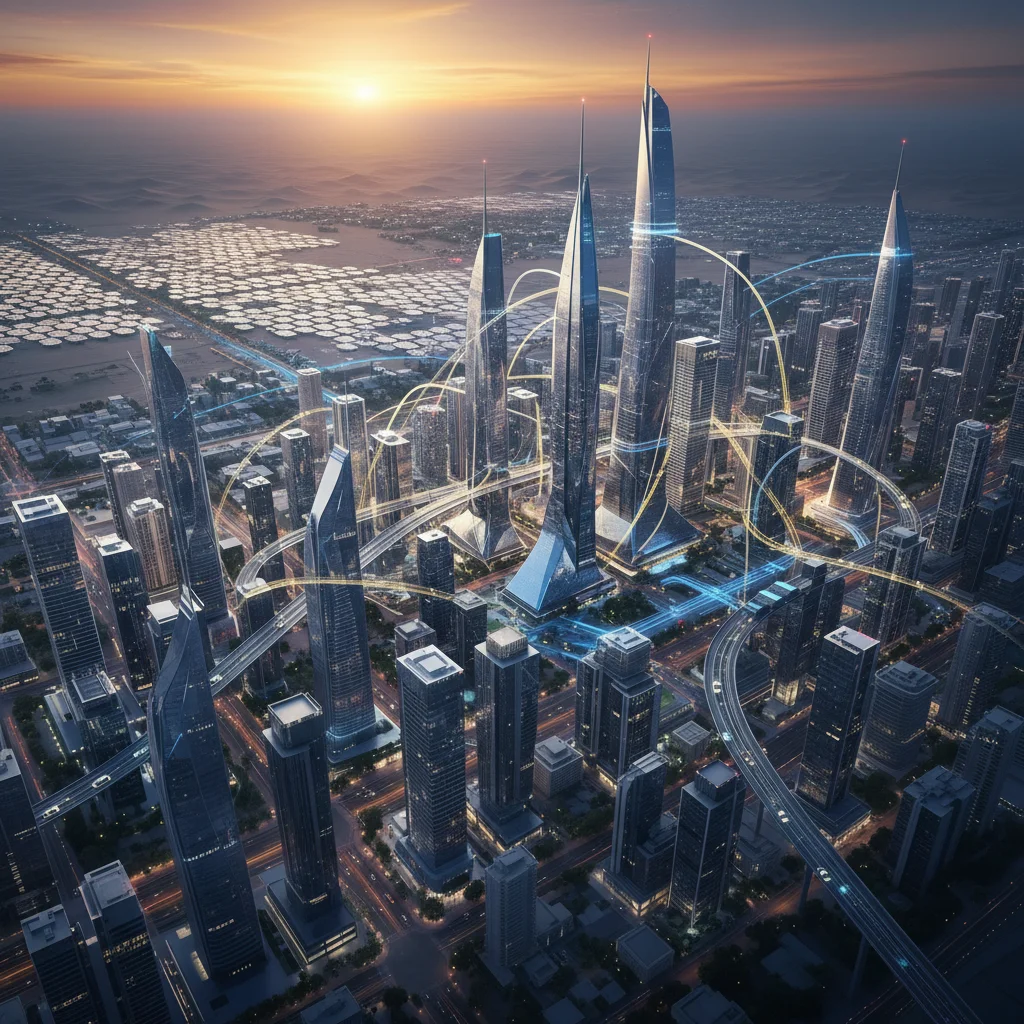
[IMAGE: A futuristic aerial view of a Middle Eastern city skyline at dusk, with sleek glass towers reflecting golden sunlight, a massive solar farm on the outskirts, and digital data streams (abstract lines of light) flowing between buildings and a central financial district. No text, no watermark.]